
A draft summary of the proposed amendment to the UO Campus Plan Principle 1 and frequently asked questions can be accessed using the following links:
Campus Plan Principle 1 Amendment - Summary
Frequently Asked Questions
Purpose
Amendments to the Campus Plan (the Plan) Principle 1: Process and Participation are necessary to ensure the Plan remains an effective guide for campus development. Principle 1 outlines a structured planning process, based on broad participation. The tenets of a participatory process will remain unchanged; however, the university’s current project delivery methods, internal workflows, and best practices have evolved requiring updates to the Plan. Amendments to Principle 1 ensure the Plan remains relevant and establishes procedures to best engage campus stakeholders and deliver construction projects.
Background
The UO Campus Plan is based on a publication called "The Oregon Experiment" – it has evolved over time, since 1975, and continues to evolve. The core intent of user participation has remained the same, however, the way we deliver construction projects has continued to evolve. We continue to evaluate what is working well in the plan and where there are opportunities to ensure that the plan is relevant and best meets the needs of the institution. (“The Oregon Experiment" (1975), is a seminal book by architect Christopher Alexander and colleagues detailing a revolutionary, user-driven, and incremental planning process implemented at the University of Oregon. It rejected traditional, centralized master planning in favor of community participation and "patterns" to create humane, organic campus growth).
Scope
- Update the process related to construction projects by removing the very prescriptive outline of process in the Campus Plan.
- Reconfigure the project participants and roles on a project by removing "User Group" and replacing with structured groups of stakeholders with outlined roles and responsibilities.
- Remove elements that are no longer relevant or can be modified to better align the policy with current practice, E.g., academic planning coordination, the capital construction budget request, the biennial capacity plan (BCP), the CPC role in architect selection, and the appeals process.
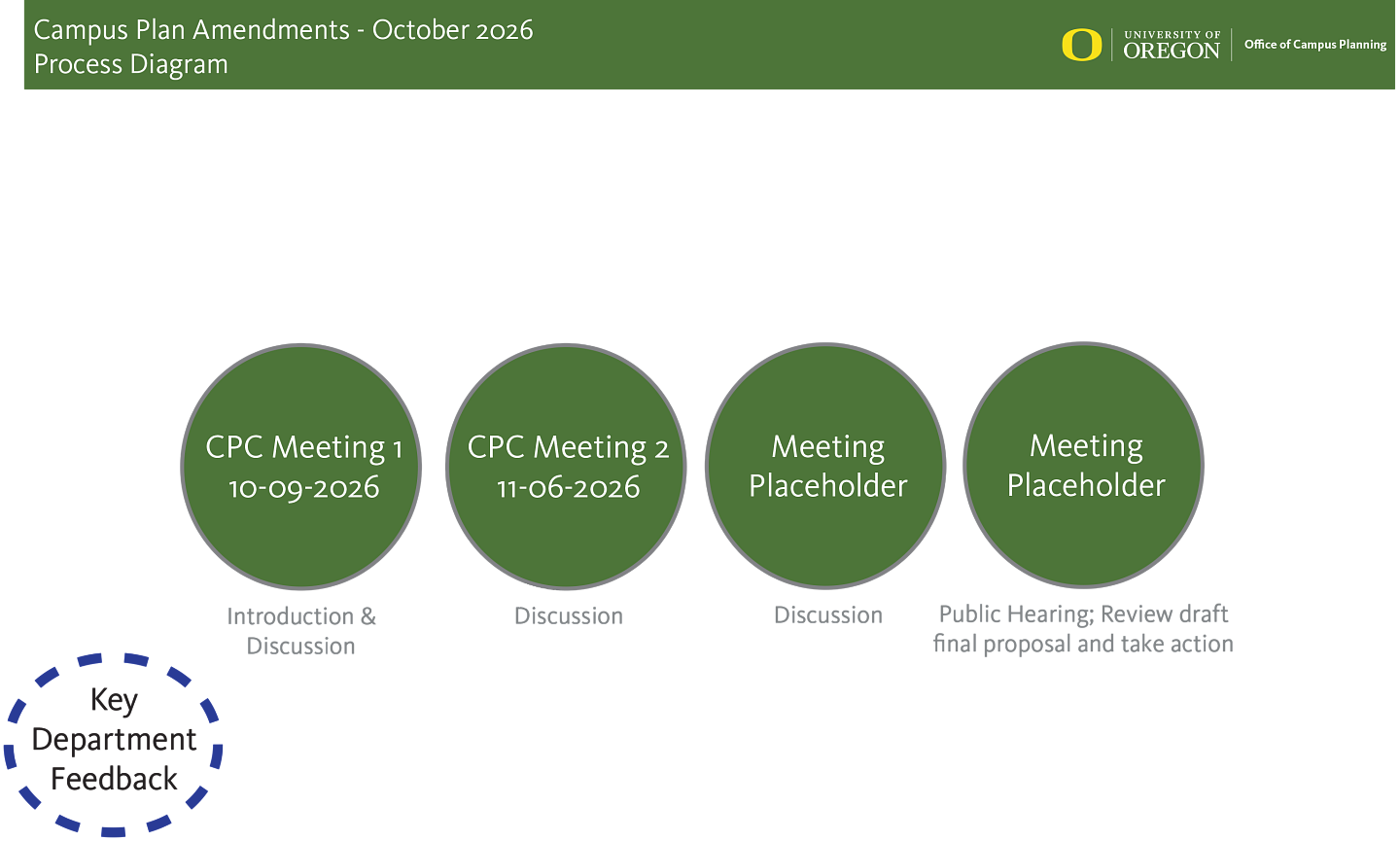
Process & Engagement
Campus Planning Committee Meetings
- October 9, 2026
- Meeting Mailing
- Meeting Record (coming soon)
- Presentation
- November 6, 2026 (coming soon)
Background Information
Campus Plan
Campus Plan Principle 1: Process and Participation
The Oregon Experiment
For additional information, please contact:
Liz Thorstenson, ASLA, RLA
Planning Associate - Historic Preservation
lizt@uoregon.edu
541-346-5024